
Unpacking the Future of Bioplastics Packaging with AI

As transformative and useful the development of plastics has been to all industries, the world is grappling with severe environmental challenges that comes with widespread use of plastics, especially plastic packaging. This is where bioplastics come in, these materials offer a promising sustainable alternative. This article explores how Artificial Intelligence (AI) is revolutionizing the development of new biopolymers for more sustainable packaging solutions. We examine the polymer discovery pipeline and showcase a case study on AI's efficacy in predicting bioplastic properties, emphasizing the importance of interdisciplinary collaboration among academia, industry, and policymakers in driving forward these innovations.
The Essential Role of Plastics in Modern Packaging
Plastics have transformed the packaging industry with their flexibility, durability, and cost-effectiveness. Let's take a closer look at some common packaging plastics:
- Polyethylene Terephthalate (PET): Renowned for its clarity and strength, PET is commonly used in beverage bottles.
- Polyethylene (PE): A versatile thermoplastic that offers excellent moisture resistance, making it ideal for food packaging.
- Polypropylene (PP): Characterized by its low density and high heat resistance, PP is widely used in various packaging applications.
The global plastic market reached a staggering $712 billion in 2023, with packaging consuming the largest share. However, this extensive use has severe environmental repercussions, contributing significantly to greenhouse gas (GHG) emissions, air and water pollution, and resource depletion. Especially destructive to various ecosystems (and increasingly, our own health) is the increase in microplastics.
The Environmental Toll of Plastic Packaging
Plastic production relies heavily on non-renewable fossil fuels, leading to considerable GHG emissions. Alarmingly, plastics are responsible for approximately 3-8% of global GHG emissions, a figure expected to double by 2060. Additionally, around 11 million metric tons of plastic waste enter our oceans annually, posing grave threats to marine life and ecosystems. Microplastics, which can accumulate toxic chemicals, have even been detected in remote regions, highlighting their pervasive spread.

Fig 1: Annual Packaging volume for select companies from 2020-2022
Addressing this issue requires sustainable production, improved waste management, reduced plastic use, and the development of environmentally friendly alternatives. Enter bioplastics — a promising solution derived from renewable biomass sources that offer a reduced carbon footprint and biodegradability.
Bioplastics: A Beacon of Hope
Bioplastics, made from renewable sources such as vegetable fats, oils, corn starch, and cellulose, offer an eco-friendly alternative to conventional plastics. Common types of bioplastics include:
- Cellulose Acetate: Derived from plant or wood fibers.
- Polyhydroxyalkanoate (PHA): Produced from sugar or glucose.
- Polylactic Acid (PLA): Made from sugarcane, sugar beets, or corn.
The flexibility of biopolymers to adjust their properties makes them attractive alternatives. However, designing new biopolymers is a complex process. This is where AI and machine learning (ML) come into play, streamlining and accelerating the development of bioplastics.
AI for Biopolymers: A Deep Dive
The application of AI in polymer science has seen significant growth, particularly in the quest for sustainable materials. AI-driven techniques offer a transformative approach to developing and optimizing bioplastics. Here's a detailed look at how AI can revolutionize biopolymer innovation:
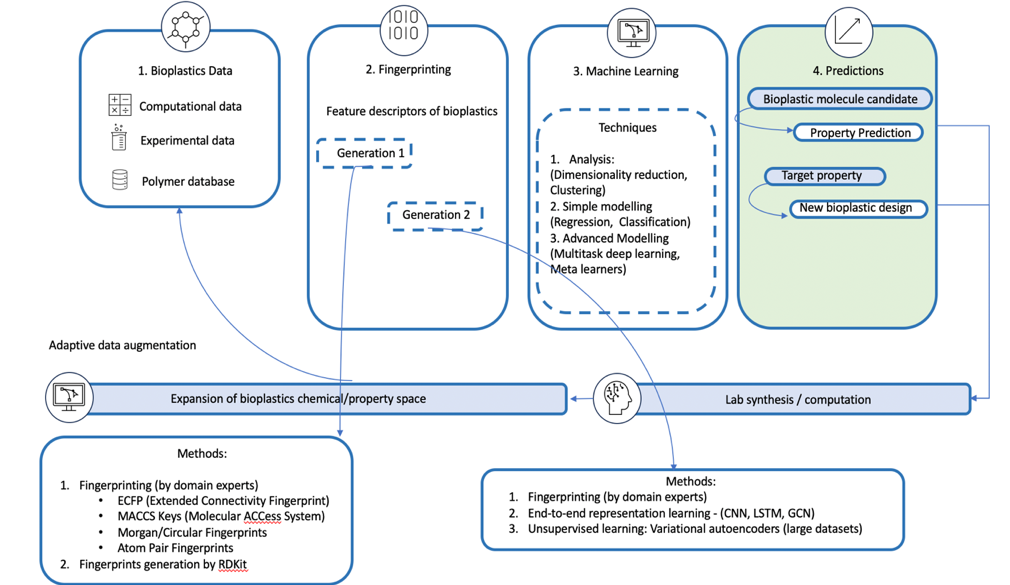
Fig 2: AI pipeline for Bioplastics. In Gen I, traditional methods are used where domain experts prepare manual fingerprints which are then leveraged for model training. In Gen II, the process of fingerprinting can be automated using suitable deep-learning architecture
Database Generation
Creating a comprehensive and machine-readable database is the first crucial step. This involves collecting data on known polymers and biopolymers, including their structures and properties. For bioplastics, data can come from existing databases or be extracted from scientific literature. For instance, PolyInfo and Khazana are notable databases that store extensive polymer properties.
Natural Language Processing (NLP) techniques, like Named Entity Recognition (NER), can be employed to extract relevant information from literature. By using advanced algorithms, researchers can effectively retrieve data on polymer names, properties, experimental results, and more. This information can populate databases, making them rich sources for AI models.
Fingerprinting: Transforming Data for AI Models
Once the data is collected, it needs to be transformed into a format suitable for AI models. This process, known as fingerprinting, involves encoding chemical structures into numerical or binary representations. Common methods include:
- SMILES (Simplified Molecular Input Line Entry System): A shorthand notation for describing the structure of chemical substances using text strings.
- Extended Connectivity Fingerprint (ECFP): Breaks down molecules into circular atom neighborhoods.
- MACCS Keys: A set of predefined structural keys for similarity searching and clustering.
- Morgan Fingerprinting: Encodes circular substructures of molecules.
Converting the structural information of polymer chains into these formats enables us to use Next-Gen fingerprinting methods as described in Fig 2. Hierarchical fingerprinting methods can further enhance prediction accuracy by capturing information from atomic to morphological levels.
Model Learning: Training AI to Predict Polymer Properties
Training AI models involves using the fingerprinted data to predict the properties of biopolymers. Various deep learning architectures, such as Recurrent Neural Networks (RNNs) and Convolutional Neural Networks (CNNs), can be employed for this purpose:
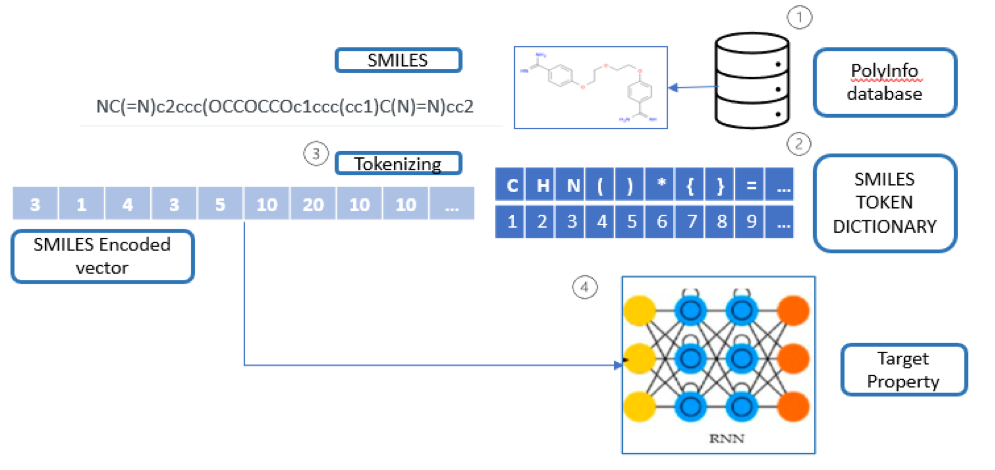
Fig 3: Illustration showcasing an example scheme of utilizing RNN for fingerprinting and model training in the AI pipeline for polymers like bioplastics
- Recurrent Neural Networks (RNNs): Ideal for modeling sequential data, RNNs capture the temporal dependencies and sequential patterns in polymer chains. This allows them to learn representations that encode the structural characteristics of the polymer effectively.
- Convolutional Neural Networks (CNNs): By organizing digital input attributes into image-like formats, CNNs detect spatial patterns and learn hierarchical features. This makes them suitable for fingerprinting chain-structured polymers, capturing complex relationships between atoms and bonds.
Additionally, Graph Neural Networks (GNNs) can operate on graph-structured data, directly processing connectivity information to capture relational dependencies crucial for determining polymer properties. Variational Autoencoders (VAEs) offer a promising advancement by automatically transforming data into features, enhancing prediction outcomes.
Multitask Learning: Enhancing Model Performance
A multitask deep neural network can be particularly effective for predicting multiple properties simultaneously. This approach leverages shared knowledge across tasks, improving overall learning and performance. For instance, a model can predict different thermal properties (e.g., melting temperature and degradation temperature) of a new biopolymer molecule concurrently, utilizing shared representations and enhancing generalization.
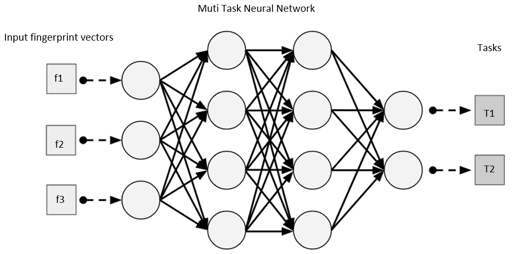
Fig 4: Illustration showing the working of Multi-Task Neural Network that uses shared knowledge between input tasks to enhance the learning process.
Validating AI Predictions
Validation is crucial to ensure the reliability of AI predictions. Various metrics, such as mean squared error (MSE) and root mean squared error (RMSE), quantify the difference between predicted and actual values. Techniques like permutation feature importance or SHAP (SHapley Additive exPlanations) values can analyze feature importance, identifying key predictors and potential areas for improvement. Input from domain experts and experimental verification of predictions further enhance model robustness.
Case Study: Discovering Replacement Bioplastics
A compelling example of AI's potential is a 2022 study by Pilania et al., which developed a multitask deep neural network to predict the properties of PHA-based bioplastics. PHAs, synthesized by microorganisms using renewable resources, offer tailored mechanical and thermal properties. The study faced challenges like chemical complexity, resource-intensive experimentation, and data sparsity. By curating a dataset and using deep neural networks, researchers identified promising PHA-based bioplastics from over a million candidates. This approach demonstrated AI's power in accelerating the discovery of sustainable materials.
The Path Forward: Challenges and Opportunities
The widespread use of plastics has undoubtedly revolutionized many industries, offering unparalleled versatility and cost-effectiveness. However, this comes at a significant environmental cost. Bioplastics, as renewable and biodegradable alternatives, can mitigate these impacts. Integrating AI techniques in biopolymer research accelerates the development and optimization of bioplastics by creating Next-Gen models as described in Fig 5.
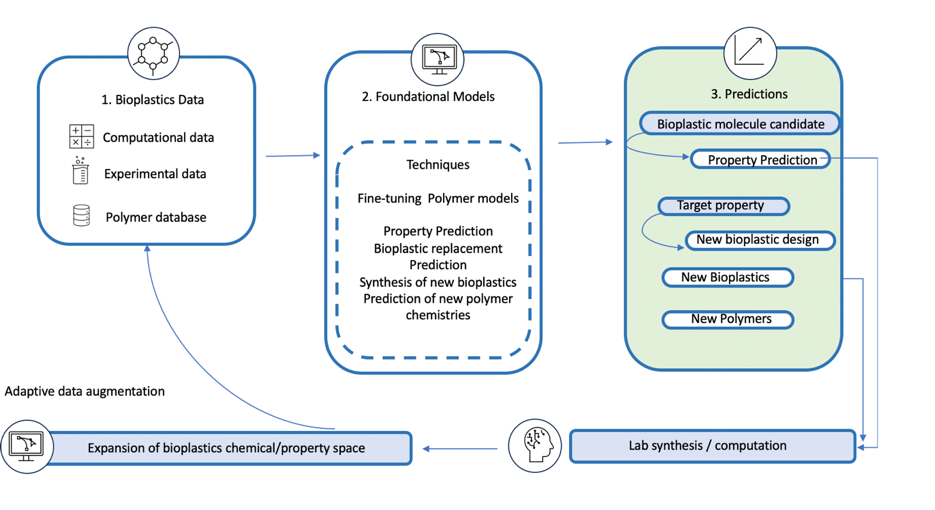
Fig 5: Illustration exploring the potential development of Next-Gen Biopolymer models with an inherent understanding of polymer structure and properties to predict target properties and hypothetical Bioplastics.
Looking ahead, the future of bioplastics with AI-driven polymer research holds immense promise. Advancements in AI, coupled with innovations in biopolymer synthesis and processing, will continue to drive the development of next-generation sustainable materials. However, several challenges remain:
- Data Availability: The lack of structured data on biopolymers hampers the development of robust AI models.
- Interdisciplinary Collaboration: Experts in AI and polymer science must collaborate to share knowledge and drive progress.
- Regulatory Support: Policymakers need to establish clear guidelines and standards for bioplastic production, use, and disposal.
With collaborative efforts from academia, industry, and policymakers, we can foster a conducive environment for the innovation and adoption of bioplastics and sustainable packaging practices. The convergence of bioplastics and AI-driven research offers a pathway toward a more sustainable future, redefining our relationship with materials for generations to come.
References
- Treaty, S. C. F. A. E. P., Karalı, N., Palm, E., Baztán, J. M. E., Gomes, P., Khanna, N., Kvale, K., Lacerda, A. L., & Jorgenson, B. (2023, May 26). Policy Brief: Climate change impacts of plastics. Zenodo (CERN European Organization for Nuclear Research). https://doi.org/10.5281/zenodo.7972056
- A. Di Bartolo, G. Infurna, and N. T. Dintcheva, “A Review of Bioplastics and Their Adoption in the Circular Economy,” Polymers, vol. 13, no. 8, p. 1229, Apr. 2021, doi: https://doi.org/10.3390/polym13081229
- L. Chen et al, “Polymer informatics: Current status and critical next steps,” Materials Science and Engineering: R: Reports, vol. 144, p. 100595 Apr. 2021, doi: https://doi.org/10.1016/j.mser.2020. 100595.
- C. Kim, R. Batra, L. Chen, H. Tran, and R. Ramprasad, “Polymer design using genetic algorithm and machine learning,” Computational Materials Science, vol. 186, p. 110067, Jan. 2021, doi: https://doi.org/10.1016/j.commatsci.2020.110067.
- R. A. Patel and M. A. Webb, “Data-Driven Design of Polymer-Based Biomaterials: High-throughput Simulation, Experimentation, and Machine Learning,” ACS applied bio materials, vol. 7, no. 2, pp. 510-527, Jan. 2023, doi: https://doi.org/10.1021/acsabm.2c00962.
- C. Kuenneth, W. Schertzer, and R. Ramprasad, “Copolymer Informatics with Multitask Deep Neural Networks,” Macromolecules, vol. 54, no. 13, pp. 5957-5961, Jun. 2021, doi: https://doi.org/10.1021/acs.macromol.1c00728
- Kuenneth, C., Lalonde, J., Marrone, B. L., Iverson, C. N., Ramprasad, R., & Pilania, G. (2022, December 3). Bioplastic design using multitask deep neural networks. Communications Materials, 3. https://doi.org/10.1038/s43246-022-00319-2
- Martin, T. B., & Audus, D. J. (2023, January 18). Emerging Trends in Machine Learning: A Polymer Perspective. ACS Polymers Au, 3(3), 239-258. https://doi.org/10.1021/acspolymersau.2c00053