
June 2026 · Compiled from peer-reviewed and public sources
Introduction — what this review covers, and who it's for
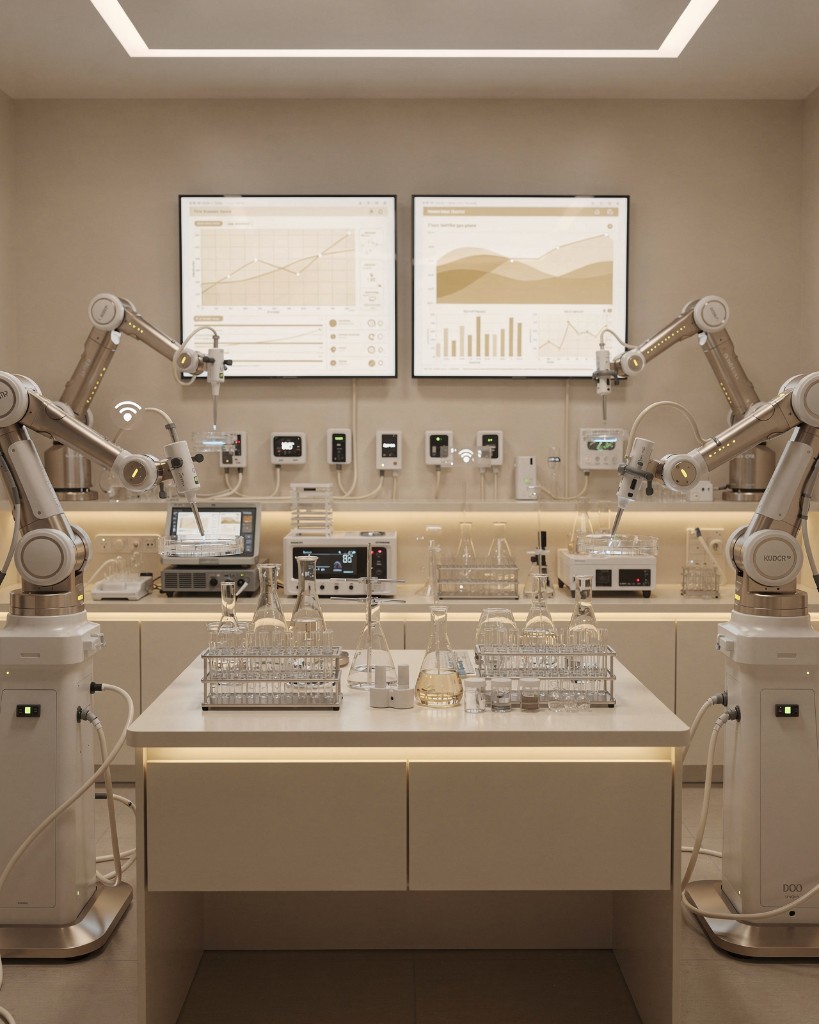
For most of the history of chemistry and materials science, discovery has moved at the speed of human hands. A scientist designs an experiment, a technician runs it, and days or weeks later someone reads the result and decides what to try next. Self-driving laboratories (SDLs) break that rhythm by handing the repetitive execution to robots and the moment-to-moment planning to AI, so the design-make-test-analyze loop runs continuously and learns from every result, with scientists steering rather than running each step by hand.
This review is a field guide to that shift. It walks through the full stack an SDL is built from — the software, the hardware, the decision algorithms, the digital twins, the interoperability standards, and the design patterns that recur across systems that actually work. Each claim is grounded in peer-reviewed research and primary sources. It also maps the people and money behind the field: the anchor institutions, the commercial vendors, the size of the market, and where in the world the building is actually happening.
If you're an R&D / manufacturing leader, or a technical leader looking to understand the current state autonomous discovery capabilities and its economics, this article doubles as a reference architecture, with concrete tooling named at every layer.
The truth is that "Self-driving" is one of the most oversold phrases in the lab-tech market, so this review tries to stay honest: it separates demonstrated results from marketing, flags the problems the field has not yet solved, and points out where a celebrated result was later contested. It is deliberately vendor-neutral throughout. Only the final section turns to where our own platform, bodh scientific™, fits the architecture it describes.
This article starts by defining what an SDL is and asks how autonomous "self-driving" really means. Sections 3–7 walk down the technical stack — architecture, the decision brain, the hardware, the digital twin, and the interoperability layer that ties them together. Section 8 gathers the landmark case studies. Section 9 covers the commercial landscape, the market size, and the geography of who is building where. Finally, it discusses the hard-won lessons on current open problems, and the principles that follow from them. The last section is for leaders evaluating bodh scientific™ specifically.
Contents
Executive summary
1. What a self-driving lab actually is
1.1 The closed loop, concretely
1.2 Why it matters now: the discovery–to–deployment gap
2. The autonomy spectrum: how "self-driving" is it really?
3. Anatomy of an SDL: the layered architecture
4. The decision brain: active learning & Bayesian optimization
4.1 The open-source optimizer ecosystem
5. Hardware & robotics: four archetypes
6. Digital twins & simulation
7. Interoperability: the real bottleneck
8. Landmark case studies (the evidence base)
9. The commercial & institutional landscape
9.1 Anchor institutions
9.2 Commercial vendors (and their trade-offs)
9.3 The market opportunity
9.4 Geographic concentration: where the world is building
9.5 Who is actually adopting it — industries and early movers
10. The hard problems
11. Design patterns & build principles
12. How bodh scientific™ fits — and the value it brings to you
12.1 What you get
12.2 The three building blocks
12.3 Why this is the right way to adopt autonomous discovery
Conclusion
Sources & references
Executive summary
A self-driving laboratory (SDL) is an autonomous experimentation platform in which automated hardware, AI decision-making, and data infrastructure close the loop between designing an experiment, running it, measuring the result, and deciding what to do next — with human intervention needed for guiding the processes. It is the design–make–test–analyze (DMTA) cycle of R&D, turned into a continuously running machine that learns from every data point.[1]
The field has moved from proof-of-concept to genuine results. Liverpool's mobile robotic chemist ran 688 experiments over 8 days to find a photocatalyst 6× more active than the starting point — work estimated to take a human months.[3] Berkeley's A-Lab synthesized 41 novel inorganic compounds in 17 days of near-continuous operation.[2] A robotic electrolyte platform ("Clio" + the "Dragonfly" optimizer) found six fast-charging electrolytes in 2 working days and 42 experiments, a 6× speed-up over the same robot searching randomly.[5] In 2024, five labs across the globe ran a single asynchronous, cloud-orchestrated campaign and discovered 21 new organic laser emitters.[6]
Three conclusions matter most for an infrastructure strategy. First, hardware is no longer the hard part — software and data are. An SDL is fundamentally a software system that happens to control instruments. Second, the realistic target is not full autonomy. 'Level 5' unsupervised labs are an aspiration, but regulated and multi-user environments deployed at supervisory autonomy ('Level 4') is where we should aim to reach. Here, the scientist sets objectives and retains veto power. Third, interoperability is the bottleneck. The winners will be those who capture fragmented instrument protocols and turn messy, unstructured lab knowledge into machine-readable, reusable assets.
This is no longer only an academic pursuit. Commercial adoption is concentrating in a handful of high-value verticals — batteries, specialty chemicals, semiconductors, catalysts, and pharma.
1. What a self-driving lab actually is
An SDL is a closed control loop over the scientific method. A traditional lab runs DMTA cycles manually: a scientist designs experiments, a technician makes and tests samples, and later someone analyzes the data and decides the next batch. An SDL automates the execution and autonomizes the planning, so the loop runs without stopping for human deliberation between iterations.[1]
1.1 The closed loop, concretely
- Design / Plan — an AI "experiment planner" proposes the next experiment(s) to run, given everything measured so far. This is usually active learning, not a fixed grid.
- Make — robotics and automated reactors physically prepare the sample: dispensing, weighing, mixing, heating, synthesizing.
- Test — in-line or at-line analytical instruments measure the property of interest (XRD, NMR, UV-Vis, conductivity, etc.).
- Analyze / Learn — results are parsed into structured data, the model is updated, and the loop returns to step 1.
The defining word is autonomous, not merely automated. High-throughput screening is automated — it executes a rigid, pre-written sequence very fast but has no awareness of what the data means. An SDL is autonomous because the choice of the next experiment is made by the system in response to incoming evidence. That distinction is the entire value proposition: an SDL spends its experimental budget where information is densest instead of blindly tiling a search space.[1]
1.2 Why it matters now: the discovery–to–deployment gap
Computational screening (and lately generative AI) can now propose millions of candidate materials and molecules. The bottleneck has shifted downstream: synthesizing, characterizing, and validating those candidates in the physical world, then scaling the survivors. SDLs are the instrument for closing that gap by making the physical-world loop fast, cheap, and data-rich.[22] But before anyone claims to have closed it, it is worth asking how autonomous these "self-driving" systems really are because this is where the marketing and the reality tend to part ways.
2. The autonomy spectrum: how "self-driving" is it really?
Borrowing from the SAE Levels 0–5 used for autonomous vehicles, the community uses an autonomy scale to keep claims honest.
| Level | State | What it means in the lab |
|---|---|---|
| 0–1 | Manual / scripted automation | Robots execute a fixed sequence fast (classic high-throughput screening). No semantic awareness; often >99% of measurements land on uninformative regions of the search space. |
| 2 | Assisted optimization | A human still designs the campaign, but an algorithm suggests promising conditions within it. |
| 3 | Heuristic / closed-loop autonomy | The system chooses its own next experiments via active learning and runs the DMTA loop unattended. This is where true SDL behavior begins. |
| 4 | Supervisory autonomy | The AI runs campaigns, coordinates multi-objective trade-offs, and flags anomalies; the scientist sets objectives and holds veto power. The realistic deployment target for regulated / shared facilities. |
| 5 | Full autonomy | System forms hypotheses, runs experiments, and updates its world model with no human in the loop. Demonstrated in narrow settings (e.g., A-Lab); an aspiration, not a deployable default. |
Level 4 is the commercially and operationally sound target. Recent taxonomy work argues explicitly that the heuristic efficiency of Level 3 plus the supervisory safety of Level 4 — not the unconstrained curiosity of Level 5 — is what suits multi-user national facilities and any GxP-regulated environment, where the cost of an unsupervised failure is unacceptable and AI outputs must be treated as recommendations requiring human approval.[24]
Once you have settled on the autonomy level you are building toward, the question becomes how to build it. Here the field has quietly converged: almost every working SDL is assembled from the same stack of layers.
3. Anatomy of an SDL: the layered architecture
Across published platforms a consistent modular, layered architecture emerges. Each layer abstracts the one below it, which is what lets a lab swap a pipettor or relocate a workflow without rewriting the whole system. This hardware/software abstraction is the single most important design pattern in the field.[1]
| Layer | Role & Representative Tooling |
|---|---|
| Human oversight | Goal-setting, approvals, audit, anomaly review. The "supervisory" layer that makes Level-4 autonomy safe and compliant. |
| Decision engine | Active learning / Bayesian optimization that picks the next experiment. Olympus, Gryffin, Atlas, BoTorch/Ax, Dragonfly. |
| Orchestration | Workflow scheduling, resource reservation, state management across instruments. AlabOS, ChemOS 2.0, IvoryOS, HELAO, Bluesky Run Engine, WEI. |
| Data & knowledge | Structured capture, provenance, and a knowledge graph/ontology linking materials, processes, and results. FAIR data; AnIML; dynamic knowledge graphs. |
| Digital twin | Simulation / surrogate of the physical lab for in-silico testing of workflows before they touch hardware. MATTERIX; frugal twins. |
| Instrument drivers / protocols | Vendor-neutral control + data exchange. SiLA 2, OPC UA LADS, AnIML; emerging agent protocols (MCP, LAP). |
| Hardware | Robot arms, liquid handlers, mobile robots, flow reactors, analytical instruments, IoT sensors. |
Of those seven layers, one decides whether a lab accelerates: the decision engine. It is worth understanding on its own terms.
4. The decision brain: active learning & Bayesian optimization
The intelligence of an SDL lives in how it chooses experiments. The dominant paradigm is Bayesian optimization (BO), which replaces static Design-of-Experiments grids with an adaptive loop built from two parts:
- A surrogate model, which is usually a Gaussian Process (GP), that maps the experimental parameters (composition, temperature, time…) to the target property and, crucially, quantifies its own uncertainty across the unexplored space.
- An acquisition function (e.g., Expected Improvement) that uses the surrogate to pick the next point by balancing exploitation (sample where the model predicts good results) against exploration (sample where the model is uncertain and could learn the most).
This is why an SDL can find a strong result in dozens of experiments instead of thousands: each new measurement is chosen to maximize information, and the model improves after every cycle.[7] In plain words, the system keeps a running best-guess of how your ingredients and settings map to the result, plus an honest map of where it is still unsure. Each round it runs the one experiment that will teach it the most. The "surrogate model" is that best-guess map; the "acquisition function" is the rule it uses to pick the next shot.
4.1 The open-source optimizer ecosystem
| Library | What it provides |
|---|---|
| BoTorch / Ax / GPyTorch | Meta's PyTorch-based BO foundation. BoTorch is the customizable engine; Ax is the higher-level adaptive-experimentation platform on top. The de-facto building blocks. |
| Olympus | Benchmarking + standardized interface for planners and experiment emulators — lets you compare optimizers on realistic surfaces. |
| Gryffin | BO for categorical / mixed variables (e.g., "which ligand" as well as "how much") — common in real chemistry. |
| Atlas | A "brain for SDLs" built on PyTorch/GPyTorch/BoTorch, exposed via Olympus. Handles mixed parameters, multi-objective, noisy, constrained, multi-fidelity, and meta-learning (reusing prior campaigns) — i.e., real-world experimental messiness. |
| Dragonfly | Scalable BO used by the "Clio" electrolyte SDL; good for higher-dimensional search. |
Frontier directions worth tracking: multi-objective optimization (trade conductivity vs. stability vs. cost simultaneously), multi-fidelity (mix cheap simulations with expensive experiments), meta-learning (warm-start a new campaign from old ones), and LLM-augmented BO, where language-model agents help structure the problem and incorporate literature knowledge into the search.[7]
An optimizer, however clever, is only as useful as the hardware it can actually drive. SDL hardware comes in four recognizable shapes, each providing a different balance between flexibility, throughput, and cost.
5. Hardware & robotics: four archetypes
SDL hardware tends to fall into four recognizable patterns. Choosing among them is largely about flexibility vs. throughput vs. capital cost.
a) Fixed workcell ("station-based") — Instruments are arranged around a central robot arm or a track and samples move between fixed stations. Berkeley's A-Lab is the archetype — robotic dosing, furnaces, and XRD orchestrated to synthesize and characterize inorganic powders, realizing 41 of 58 target compounds in 17 days at a 71% success rate.[2] High throughput, lower flexibility.
b) Mobile robot ("robot roams the lab") — Instead of moving samples to a robot, a free-roaming humanoid-scale robot moves to human-designed instruments. Liverpool's mobile robotic chemist — a KUKA-based 1.75 m robot using a lab map and a gripper — ran 688 experiments over 8 days in a 10-variable space and found a 6× better photocatalyst.[3] Maximum flexibility (reuses existing human lab), at the cost of speed and engineering complexity.
c) Flow / self-optimizing reactors — Continuous-flow reactors with in-line analytics and feedback control. Flow is ideal for autonomy: better heat/mass transfer, reproducibility, and easy in-line monitoring. The Jensen group (MIT) and others couple syringe pumps, tunable photoreactors, IoT devices, and in-line NMR with closed-loop BO.[1] Critically, Flow also offers a path through the scale-up "valley of death": a 2024 Science platform demonstrated automated self-optimization and intensification/scale-up of photocatalysis in one flow system.[27]
d) Cloud lab / labs-as-a-service — The physical lab is remote and accessed entirely through software. Emerald Cloud Lab lets scientists run wet-lab work without being on-site; in 2024 it partnered with Carnegie Mellon to open the first university cloud lab.[26] This model trades capital expenditure for operating expenditure and makes "write an experiment as code" literal — but introduces dependence on a provider.
Whichever hardware a lab settles on, running experiments blind is expensive in both reagents and instrument time. That is why teams increasingly rehearse them in software first.
6. Digital twins & simulation
A digital twin is a simulation/surrogate of the SDL that lets you test workflows in silico before risking expensive hardware and reagents — and lets the decision engine reason about the system without always paying for a physical experiment.[15]
- High-fidelity physics twins. MATTERIX (2025) is a GPU-accelerated robotic-simulation framework that builds high-fidelity twins of chemistry labs — simulating robotic manipulation, powder and liquid dynamics, heat transfer, and basic reaction kinetics with photorealistic rendering. It dry-runs whole workflows before deployment.[16]
- Surrogate-model twins. ML or physics-based models that emulate full system behavior by enabling rapid mechanistic studies and "what-if" exploration far more cheaply than physical runs.[15]
- Frugal twins. Physical-but-cheap surrogates of high-end SDLs that capture core functionality at a fraction of the cost. They lower the barrier to entry, give teams hands-on autonomy experience at low risk, and are central to democratizing the technology but raise their own dual-use considerations.[17]
Twins, optimizers, and robots all rest on one quiet assumption: that the instruments can talk to each other and agree on what their data means. In practice, that assumption is where most SDLs break.
7. Interoperability: the real bottleneck
Every review converges on the same hard problem: instruments speak incompatible languages, and data lands in incompatible formats. Without vendor-neutral standards, an SDL becomes a brittle pile of one-off integrations. Three standards plus an emerging fourth class matter:
| Standard | What it does |
|---|---|
| SiLA 2 | Communication/control standard. Strongly-typed, web-tech-based (HTTP/2, RESTful patterns, JSON-friendly), focused on functionality rather than device type. Good for deterministic, multi-vendor device control; used by ChemOS 2.0. |
| OPC UA (LADS) | Industrial interoperability standard with a Laboratory & Analytical Device companion spec. Enables instruments to self-describe and be discovered automatically. Strong in production/industrial contexts. |
| AnIML | ASTM-governed XML data standard for analytical/biological data. Pairs naturally with SiLA's "how devices talk." |
| MCP / agent protocols | Emerging: schema-based tool descriptions that let AI agents discover and invoke instruments dynamically (Model Context Protocol; research protocols like LAP, EOS). Complements SiLA/OPC UA: deterministic control + agentic discovery. |
The pragmatic architecture emerging in 2026–27 is dual-protocol: SiLA 2 (or OPC UA LADS) for structured, deterministic device control, plus MCP-style descriptions so an AI agent can discover instruments and orchestrate them in natural language. SiLA and AnIML are explicitly designed to fit together for control + data.[12][14]
That is the theory of the stack. The clearest way to see how it holds together is to look at the platforms that have actually closed the loop in the real world.
8. Landmark case studies
These are the most-cited demonstrations that are useful both as proof points and as design references.
| Platform | Result · why it matters |
|---|---|
| Mobile robotic chemist (Liverpool) | 688 experiments / 8 days / 10 variables; 6× more active photocatalyst; ~months of human work compressed to days. The mobile-robot archetype. |
| Clio + Dragonfly (battery electrolytes) | 6 fast-charging electrolytes in 2 working days / 42 experiments; 6× faster than random search. Clean demonstration of BO-driven acceleration with a quantified baseline. |
| A-Lab (Berkeley/LBNL) | 41 novel inorganic compounds from 58 targets in 17 days, ~21 experiments/day, 71% success. Computation + literature + ML + active learning + robotics, end-to-end. (See the integrity debate in §10.) |
| Coscientist (CMU) | GPT-4-driven agent that plans, codes, and executes experiments from a plain-English prompt; optimized Pd-catalyzed cross-couplings. The first convincing LLM-as-lab-director demo. |
| Organic laser emitters (5-lab collaboration) | 21 new state-of-the-art materials via delocalized, asynchronous, cloud-orchestrated DMTA across 5 global labs. A blueprint for distributed/federated SDLs. |
| Polybot (Argonne) | Multi-robot SDL for electronic polymers (synthesis, processing, mobile transport). Argonne frames the promise as years→months and millions→thousands. |
9. The commercial & institutional landscape
9.1 Anchor institutions
Acceleration Consortium (University of Toronto), led by Alán Aspuru-Guzik, is the field's center of gravity: a $200M CFREF grant (the largest in Canadian university history), 6+ self-driving labs, and much of the open-source tooling (Olympus, Gryffin, Atlas, the awesome-self-driving-labs resource list). National labs anchor the rest: Berkeley/LBNL (A-Lab) and Argonne (Polybot).[18][19]
9.2 Commercial vendors (and their trade-offs)
- Atinary — commercialized from ChemOS; launched a Boston "Scientific Discovery Factory" running closed-loop Design-Make-Test-Analyze-Learn cycles; sells AI optimization + orchestration as software.[25]
- Emerald Cloud Lab — full cloud-lab / labs-as-a-service; opened the first university cloud lab with CMU in 2024.[26]
- bodh scientific™ (SarthhakAI), Kebotix, Citrine Informatics — materials-informatics / autonomous-discovery players bridging ML property prediction and experimental loops. bodh scientific™ is covered in depth in §12; its emphasis is on owning the intelligence, data, and trust layers (model-agnostic and hardware-agnostic) rather than selling robotics.
- Chemspeed + SciY / Bruker — in 2026 announced an integrated SDL platform combining automation hardware, analytics, and AI orchestration; signals incumbents moving in.[30]
9.3 The market opportunity
There is no clean, standalone "self-driving lab" market figure yet. An SDL sits at the intersection of two markets analysts do track, and both are growing quickly.
The first is lab automation — the robots, liquid handlers, and orchestration software an SDL physically runs on. Estimates vary by scope, but it sat at roughly $5.8–8.3 billion in 2024 and is projected to reach about $9–18 billion by the early 2030s, a ~7–9% compound annual growth rate (CAGR).
The second is AI for discovery — the decision-making brain. It is smaller today but growing far faster. AI in drug discovery alone was about $1.5–1.7 billion in 2023–24 and is forecast to reach roughly $8–11 billion by 2030, a ~25–36% CAGR; materials and chemistry are on the same curve a few years behind.[33]
The real prize sits underneath both numbers. The Acceleration Consortium frames it directly: collapsing the 10–20 years and ~$100M it takes to move a new material from discovery to market toward ~1 year and ~$1M — a 10–100× compression in time and cost.[17] That is the value an SDL is built to capture, and it is why public and private money is now moving into the space.[34]
9.4 Geographic concentration: where the world is building
SDL activity clusters in five blocks, each with a distinct character.
- United States & Canada — the research center of gravity. Canada hosts the field's anchor, the Acceleration Consortium at the University of Toronto, backed by a $200M grant (the largest in Canadian university history).[17] In the US, the national labs lead the hardware demonstrations — Berkeley's A-Lab and Argonne's Polybot — while federal science agencies fund the next wave, including a $2M NSF grant to an NC State-led SDL team in 2025 alongside DOE and NSF materials-platform programs. North America's ~37% share of the lab-automation market reflects that depth.[35][31]
- China — fast-scaling and state-backed. China has moved from algorithm-driven systems to large-model-driven "autonomous labs," anchored by the Chinese Academy of Sciences' AI-Scientist platform and USTC's robot chemist.[36] It was discovered that an AI chemist that screened 3.76 million candidate catalyst formulas from Martian-meteorite feedstock and found an optimum in about six weeks — work estimated at roughly 2,000 years of human labor.[37] National AI funding now rivals US levels, and the stated direction is networked, distributed autonomous labs.
- European Union — coordinated and sustainability-focused. The EU's flagship is Battery2030+, a €150M+ initiative whose largest project, BIG-MAP, is building an autonomous "self-driving" lab for battery materials (the Aurora robot platform) and targeting a ~10× (5–10×) acceleration in discovery.[38] The European model is consortium-led and standards-conscious, in keeping with its regulatory culture.
- India — emerging, talent-rich, early-stage. Groups such as the AiREX Lab at IISc Bangalore and teams at IIIT-Hyderabad are building toward autonomous materials-discovery labs, leaning on the country's deep AI, computer-science, and computational-science base.[39][40] The opening is to pair that software strength with domestic R&D and manufacturing demand.
- Rest of Asia — strong pockets. Japan (materials-informatics programs at NIMS), South Korea, and Singapore (A*STAR) are active in lab automation and materials informatics, though large public SDL flagships are less consolidated than in the US, China, or EU.
9.5 Who is actually adopting it — industries and early movers
The institutions in §9.1 prove the science. The more useful question for a commercial buyer is which companies are spending on it, and in which sectors. Adoption is real but uneven, and it clusters in high-value, formulation-heavy verticals where a faster discovery loop pays for itself quickly.
- Batteries & energy storage — the clearest early adopter. Industry reports describe BASF building high-throughput robotic automation for electrode and battery-material development and Samsung SDI automating battery testing toward continuous operation;[47] Panasonic is a named customer of materials-AI vendor Citrine Informatics.[44] EV and grid-storage demand, plus well-defined target properties, make batteries an ideal first use case.
- Specialty & commodity chemicals and formulations. Companies such as LyondellBasell and Showa Denko use materials-informatics platforms to accelerate formulation and reformulation — adjusting a recipe to hit new performance, cost, or regulatory targets without starting over.[44] Formulation is the sweet spot: large combinatorial spaces, costly trial-and-error, and proprietary data a model can compound on.
- Semiconductors & electronic materials. The US CHIPS R&D program created a $100M initiative for self-driving labs to accelerate semiconductor-material discovery,[45] and IBM has used AI plus automation to identify and synthesise a novel photoacid generator in under a year.[46] OLED and display materials are an active sub-front.
- Catalysts. DOE's ARPA-E created a $40M program for self-driving labs aimed specifically at discovering new chemical catalysts providing a clear signal of where government and industry expect outsized returns.[45] NVIDIA's ALCHEMI materials toolkit lists catalysts among its first target workloads.
- Coatings, consumer & personal care. Paints, coatings, and cosmetics are formulation-heavy and regulation-sensitive. Materials-AI vendors increasingly target consumer-goods R&D.
- Pharma & biotech. The largest AI-for-discovery budgets sit here, and cloud-lab providers (Emerald, §5) and LLM-driven planners (Coscientist, §8) are already used for synthesis route-finding and optimisation.
Regarding size: the commercial software layer that powers this is the materials-informatics market, investing roughly $155–250 million in 2024 but is forecast to reach about $1.3–1.6 billion by the mid-2030s (≈20–26% CAGR). Chemicals and pharmaceuticals the largest end-use segment; one analyst breakdown puts manufacturing at ~40% of the market, pharma/healthcare ~25%, and energy/environment ~20%.[41][42][43] That figure is deliberately narrow as it captures the AI/data software, not the robots or the broader AI-drug-discovery market bracketed in §9.3. However, it is the cleanest proxy for commercial SDL software demand, and it is compounding fast. Vendors and early adopters report development cycles cut by up to ~70% and testing costs roughly halved, which is what keeps the budgets flowing.[47]
A realistic read: outside batteries and pharma, most industrial deployments today are pilots and high-throughput augmentation, not lights-out Level-5 labs.[46] The pattern is consistent — adopt where the materials are valuable, the search space is large, and the data is proprietary. This fits the formulation-heavy, regulated territory where owning the intelligence and data layers matters most.
For all this momentum and money, the field has not solved everything. Anyone building or buying should walk in clear-eyed about the problems that remain genuinely open.
10. The hard problems
- Interoperability & FAIR data. Heterogeneous hardware and incompatible data formats produce fragmented workflows. Adhering to FAIR principles (Findable, Accessible, Interoperable, Reusable) is repeatedly named the central practical obstacle.[22]
- Reproducibility & benchmarking. Most labs report only calibration/self-validation; few include repeatability or reproducibility metrics, and there are no agreed standards for performing or enforcing such studies. "It worked once" is not yet "it works."[22]
- Scale-up. Process physics (heat transfer, mass transport, fluid dynamics) does not scale linearly with volume, so a bench-optimal recipe can fail at production scale. The field is pushing toward concurrent discovery-plus-scale-up (e.g., flow intensification) rather than the sequential screen→optimize→scale pipeline.[27]
- Capital & talent. High upfront cost, hard-to-automate manual steps, and rigid instrument designs remain real barriers, which is exactly why frugal twins and cloud labs matter for access.[17]
- Scientific-integrity scrutiny. The A-Lab Nature paper drew a published critique arguing that, on re-analysis, the claimed novel compounds were questionable; the authors disputed it with additional data, and the paper was later corrected. The lesson is not that SDLs don't work, it's that autonomous characterization and human-grade validation are themselves research problems, and trustworthy outputs need rigorous, auditable evidence.[21]
11. Design patterns & build principles
Synthesizing across platforms, a short list of patterns recurs in every successful SDL:
- Abstract hardware behind drivers. Treat every instrument as a swappable, self-describing module so workflows survive hardware changes and relocate between workcells.
- Separate orchestration from intelligence. Keep the scheduler/state-manager (AlabOS, ChemOS, Bluesky, IvoryOS) distinct from the decision engine (BO/active learning). Each evolves independently.
- Make the knowledge layer first-class. A relational knowledge graph / ontology linking materials → process → measurement turns one-off runs into a compounding, reusable asset and powers meta-learning across campaigns.[29]
- Design for FAIR from day one. Structured, provenance-rich capture (AnIML-style) is cheaper to build in than to retrofit, and is what makes results trustworthy and transferable.
- Twin before you run. Validate workflows in a digital/frugal twin to catch failures cheaply before committing reagents and instrument time.
- Build for Level 4, not Level 5. Keep the human as objective-setter and approver with full audit trails. It is safer, more compliant, and — given current reliability — more credible.
- Go dual-protocol. SiLA 2 / OPC UA LADS for deterministic control; MCP-style descriptions for agentic discovery and natural-language orchestration.
These principles describe what a serious self-driving lab actually needs.
12. How bodh scientific™ fits — and the value it brings to you
If you run an R&D or manufacturing lab and want to move from trial-and-error toward autonomous discovery, this section explains where bodh scientific™ plugs into the architecture above and what you get out of it.
The central finding of this review is that the hard part of a self-driving lab is no longer the robots but rather the intelligence, the data, and the trust wrapped around them. Instruments and reactors are increasingly off-the-shelf; what separates a lab that accelerates from one that merely automates is the decision-making, the institutional knowledge, and the discipline that make results fast, reusable, and trustworthy. bodh scientific™ is built to deliver exactly that layer — on top of the instruments you already own, without asking you to rip out your lab.
12.1 What you get
- Fewer experiments, faster answers. Our AI chooses each next experiment to maximize information, so you reach a validated formulation in a fraction of the runs a full factorial or human-led search would take.
- Your data becomes a compounding asset. Every batch, including the failures, is captured as structured, connected, reusable knowledge, so your lab gets smarter with each campaign instead of starting from scratch each time.
- Works with your instruments. We are hardware-agnostic. bodh scientific™ orchestrates multi-vendor equipment through open standards (SiLA 2 / OPC UA) plus agent-based discovery. No single-vendor lock-in.
- You stay in control. A supervisory (Level-4) design keeps your scientists as the decision-makers: the system proposes and runs, they set objectives and approve quality-critical calls with full audit trails, tenant isolation, and security controls suited to GxP-regulated environments.
- Domain expertise, not a generic model. Our models are trained for your industry's chemistry, then fine-tuned on your data so the system speaks your science from day one rather than learning it slowly on your dime.
12.2 The three building blocks
bodh scientific delivers the value above through three integrated products, each mapping to a layer of the SDL stack in §3:
| Product | What it is | What it means for you |
|---|---|---|
| Episteme Labs™ | Our industry-specific scientific models — trained on a domain in co-partnership with industry, or offered as solutions built on unique datasets for a specific industry problem, and fine-tuned on your data. | The system arrives already fluent in your field's chemistry and gets sharper on your proprietary data — far better predictions than a general-purpose model, with your IP kept yours. |
| Formulation Engine (part of the bodh scientific™ platform) | Our proprietary, in-house AI decision engine and a core part of the bodh scientific™ platform. It is the brain of the loop: it reads the evidence so far and selects the next best experiment (active learning over your formulation space). | This is what compresses hundreds of candidate experiments into dozens — the direct driver of speed-to-result and lower cost per discovery. |
| Continuum Labs | Our self-driving lab: the physical orchestration layer that turns the engine's chosen experiments into instrument actions and streams the measured results back to close the loop. | The hands of the operation — autonomous, multi-vendor execution that runs around the clock and feeds every result back into your growing scientific memory. |
Underneath these sits an active scientific knowledge layer that replaces static PDFs, SOPs, and trial logs with connected, machine-readable context. The three products and this memory form a single closed loop: Episteme models your science → the bodh scientific™ decides the next experiment → Continuum Labs runs it → the result enriches your memory and sharpens the next decision.
12.3 Why this is the right way to adopt autonomous discovery
- It attacks the real bottleneck. Independent reviews name interoperability, data discipline, and fragmented knowledge as what holds labs back.
- It protects your investment. Hardware-agnostic by design, so you keep and connect the instruments you already have, and add capability incrementally instead of all at once.
- It is built for regulated reality. Human-in-the-loop approval, provenance, reproducibility metrics, and auditability are designed in. The prerequisites for quality-critical and GxP-governed work, and the antidote to the reproducibility doubts the field has learned to take seriously.
- The value compounds. Because every campaign enriches your models and your scientific memory, the platform is worth more the longer you run it — an advantage that pure hardware or pure orchestration cannot offer.
Conclusion
A decade ago, the hard part of an autonomous lab was robotics. That problem is largely solved: arms, liquid handlers, flow reactors, and analytical instruments are increasingly off-the-shelf, and the published demonstrations prove the physical loop can close. The frontier has moved up the stack, to the software, data, and discipline that turn a fast machine into a trustworthy one.
That shift is what gives this review its through-line. The decision brain decides whether a lab accelerates or merely runs faster. The knowledge layer decides whether each campaign compounds or evaporates. Interoperability decides whether a lab is a system or a pile of one-off integrations. And the honest target is not the unsupervised Level-5 fantasy but Level-4 autonomy, where scientists keep the objectives and the veto and the audit trail — the only version that survives contact with regulated, real-world R&D. Remember that autonomous characterization and validation are still research problems in their own right, and that "it worked once" is not yet "it works."
The momentum is real and global. Lab automation and discovery AI are each multi-billion-dollar markets growing at high single to double digits, the underlying prize is a 10–100× compression in the time and cost of bringing a material to market, and serious money is moving in every major region. For anyone building or buying, the strategic conclusion is the same one the evidence keeps pointing to: hardware is rented, but the intelligence, the data, and the trust layer are owned — and that is where durable advantage in autonomous discovery will be won. It is the layer this review has argued matters most, and the layer bodh scientific™ is built to provide.
Sources & references
- Tom, Schon, et al. — Self-Driving Laboratories for Chemistry and Materials Science. Chemical Reviews, 2024. https://pubs.acs.org/doi/10.1021/acs.chemrev.4c00055
- Szymanski et al. — An autonomous laboratory for the accelerated synthesis of inorganic materials (A-Lab). Nature, 2023. https://www.nature.com/articles/s41586-023-06734-w
- Burger et al. — A mobile robotic chemist. Nature, 2020. https://www.nature.com/articles/s41586-020-2442-2
- Boiko et al. — Autonomous chemical research with large language models (Coscientist). Nature, 2023. https://www.ncbi.nlm.nih.gov/pmc/articles/PMC10733136/
- Dave et al. — Autonomous optimization of non-aqueous Li-ion battery electrolytes (Clio/Dragonfly). Nature Communications, 2022. https://www.nature.com/articles/s41467-022-32938-1
- Strieth-Kalthoff et al. — Delocalized, asynchronous, closed-loop discovery of organic laser emitters. Science, 2024. https://www.science.org/doi/10.1126/science.adk9227
- Atlas: a brain for self-driving laboratories. Digital Discovery (RSC), 2025. https://pubs.rsc.org/en/content/articlehtml/2025/dd/d4dd00115j
- Sim et al. — ChemOS 2.0: an orchestration architecture for chemical self-driving laboratories. Matter / ScienceDirect, 2024. https://www.sciencedirect.com/science/article/pii/S2590238524001954
- IvoryOS: an interoperable web interface for orchestrating Python-based self-driving laboratories. Nature Communications, 2025. https://www.nature.com/articles/s41467-025-60514-w
- Bluesky / Ophyd — experiment orchestration & hardware abstraction (Bluesky Project). https://blueskyproject.io/ophyd/
- SiLA 2: The Next Generation Lab Automation Standard (SiLA Standard). https://sila-standard.com/standards/
- How OPC UA LADS, SiLA, and Laboperator are powering the AI-enabled lab of the future. https://laboperator.com/blog/how-opc-ua-lads-sila-and-laboperator-are-powering-the-ai-enabled-lab-of-the-future
- LAP: An Agent-to-Instrument Protocol for Autonomous Science (arXiv). https://arxiv.org/html/2606.03755
- Digital twins for self-driving chemistry laboratories. Nature Computational Science, 2025. https://www.nature.com/articles/s43588-025-00908-4
- MATTERIX: toward a digital twin for robotics-assisted chemistry laboratory automation. Nature Computational Science, 2025. https://www.nature.com/articles/s43588-025-00924-4
- Review of low-cost self-driving laboratories: the "frugal twin" concept. Digital Discovery (RSC), 2024. https://pubs.rsc.org/en/content/articlehtml/2024/dd/d3dd00223c
- U of T receives $200M grant to support the Acceleration Consortium's self-driving labs research. https://www.utoronto.ca/news/u-t-receives-200-million-grant-support-acceleration-consortium-s-self-driving-labs-research
- Argonne's self-driving lab (Polybot) accelerates the discovery process for materials. https://www.anl.gov/article/argonnes-selfdriving-lab-accelerates-the-discovery-process-for-materials-with-multiple-applications
- Science acceleration and accessibility with self-driving labs. Nature Communications, 2025. https://www.nature.com/articles/s41467-025-59231-1
- New analysis raises doubts over autonomous lab's materials discoveries (A-Lab critique). Chemistry World. https://www.chemistryworld.com/news/new-analysis-raises-doubts-over-autonomous-labs-materials-discoveries/4018791.article
- Self-Driving Laboratories: Translating Materials Science from Laboratory to Factory. ACS Omega, 2025. https://pubs.acs.org/doi/10.1021/acsomega.5c02197
- Benchmarking Autonomy in Scientific Experiments: a hierarchical taxonomy (BASE scale). arXiv, 2026. https://arxiv.org/pdf/2601.06978
- Atinary launches its first self-driving lab in Boston. R&D World. https://www.rdworldonline.com/atinary-launches-its-first-self-driving-lab-in-boston/
- Emerald Cloud Lab (overview). https://en.wikipedia.org/wiki/Emerald_Cloud_Lab
- Automated self-optimization, intensification, and scale-up of photocatalysis in flow. Science, 2024. https://www.science.org/doi/10.1126/science.adj1817
- A dynamic knowledge graph approach to distributed self-driving laboratories. Nature Communications, 2024. https://www.nature.com/articles/s41467-023-44599-9
- Chemspeed & SciY (Bruker) announce integrated self-driving laboratory platform, 2026. https://ir.bruker.com/press-releases/press-release-details/2026/Chemspeed-and-SciY-Announce-SelfDriving-Laboratory-Platform-Integrating-Automation-Analytics-and-AI-Orchestration/default.aspx
- Autonomous 'self-driving' laboratories: a review of technology and applications. Royal Society Open Science, 2025. https://royalsocietypublishing.org/rsos/article/12/7/250646/235354/Autonomous-self-driving-laboratories-a-review-of
- awesome-self-driving-labs — community-curated resource list (Acceleration Consortium). https://github.com/AccelerationConsortium/awesome-self-driving-labs
- Toward self-driving laboratory 2.0 for chemistry and materials discovery. Materials Horizons (RSC), 2026. https://pubs.rsc.org/en/content/articlehtml/2026/mh/d5mh01984b
- Lab Automation Market Size & Share, Industry Report. Grand View Research. https://www.grandviewresearch.com/industry-analysis/lab-automation-market
- Lab Automation Market worth $9.01 billion by 2030. MarketsandMarkets. https://www.marketsandmarkets.com/PressReleases/lab-automation.asp
- Artificial Intelligence in Drug Discovery Market Size & Outlook. Grand View Research. https://www.grandviewresearch.com/horizon/outlook/artificial-intelligence-in-drug-discovery-ai-market-size/global
- Scaling Materials Discovery with Self-Driving Labs. Institute for Progress (IFP). https://ifp.org/scaling-materials-discovery-with-self-driving-labs/
- $2M NSF Grant for Self-Driving Labs Will Accelerate Discovery (NC State, DMREF), Sept 2025. https://engr.ncsu.edu/news/2025/09/25/2m-nsf-grant-for-self-driving-labs-will-accelerate-discovery/
- Autonomous laboratories in China: an embodied intelligence-driven platform to accelerate chemical discovery. Digital Discovery (RSC), 2025. https://pubs.rsc.org/en/content/articlelanding/2025/dd/d5dd00072f
- China's AI robotic chemist synthesizes catalysts for oxygen production on Mars. Chinese Academy of Sciences, 2023. https://english.cas.cn/newsroom/cas_media/202311/t20231115_643207.shtml
- BIG-MAP — Battery Interface Genome / Materials Acceleration Platform. Battery2030+. https://battery2030.eu/battery2030/projects/big-map/
- AiREX Lab — AI for Research and Engineering eXcellence, Centre for Data Science, IISc Bangalore. https://airexlab.cds.iisc.ac.in/
- Towards self-driving / autonomous material discovery lab. Journal of Chemical Sciences (Indian Academy of Sciences), 2025. https://www.ias.ac.in/article/fulltext/jcsc/137/0082
- Materials Informatics Market (size & forecast). Precedence Research. https://www.precedenceresearch.com/material-informatics-market
- Material Informatics Market Size & Share Report. Grand View Research. https://www.grandviewresearch.com/industry-analysis/material-informatics-market-report
- AI in Materials Discovery Market (CAGR ~26%). Market.us. https://market.us/report/ai-in-materials-discovery-market/
- Citrine Informatics — Chemical & Materials Development Platform (customers incl. Panasonic, Showa Denko, LyondellBasell). https://citrine.io/
- Self-Driving Labs: AI and Robotics Accelerating Materials Innovation (ARPA-E $40M catalysts; CHIPS $100M semiconductors). CSIS, 2025. https://www.csis.org/blogs/perspectives-innovation/self-driving-labs-ai-and-robotics-accelerating-materials-innovation
- AI materials discovery now needs to move into the real world (IBM photoacid generator; industrialization). MIT Technology Review, 2025. https://www.technologyreview.com/2025/12/15/1129210/ai-materials-science-discovery-startups-investment/
- High-Throughput Labs: industry adopters and reported ROI (BASF, Samsung SDI). Monolith AI. https://www.monolithai.com/blog/high-throughput-labs-future-of-testing
Compiled June 2026. Sources are peer-reviewed journals, national-lab and university communications, standards bodies, company disclosures, and reputable trade press. Market-size ranges reflect differing analyst scopes and are cited as such; company adoption examples drawn from trade press and vendor disclosures are as reported.